Open link ↗ berthub.eu
Reverse Engineering the source code of the BioNTech/Pfizer SARS-CoV-2 Vaccine – Articles
Welcome! In this post, we’ll be taking a character-by-character look at the
source code of the BioNTech/Pfizer SARS-CoV-2 mRNA vaccine.
*I want to thank the large cast of people who spent time previewing this
article for legibility and correctness. All mistakes remain mine though,
but I would love to hear about them quickly at [email protected] or
Now, these words may be somewhat jarring – the vaccine is a liquid that gets
injected in your arm. How can we talk about source code?
This is a good question, so let’s start off with a small part of the very
source code of the BioNTech/Pfizer vaccine, also known as
BNT162b2 , also
known as Tozinameran [also known as
Comirnaty](https://twitter.com/PowerDNS_Bert/status/1342109138965422083) .
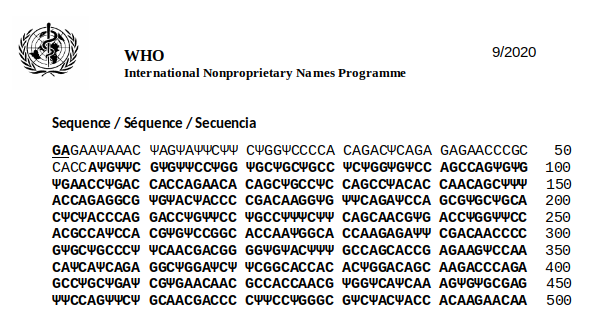
First 500 characters of the BNT162b2 mRNA. Source: World Health Organization
The BNT162b2 mRNA vaccine has this digital code at its heart. It is 4284
characters long, so it would fit in a bunch of tweets. At the very
beginning of the vaccine production process, someone uploaded this code to a
DNA printer (yes), which then converted the bytes on disk to actual DNA
molecules.
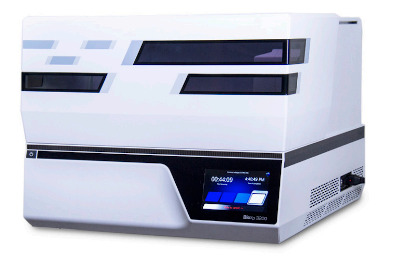
A Codex DNA BioXp 3200 DNA printer
Out of such a machine come tiny amounts of DNA, which after a lot of
biological and chemical processing end up as RNA (more about which later) in
the vaccine vial. A 30 microgram dose turns out to actually contain 30
micrograms of RNA. In addition, there is a clever lipid (fatty) packaging
system that gets the mRNA into our cells.
RNA is the volatile ‘working memory’ version of DNA. DNA is like the flash
drive storage of biology. DNA is very durable, internally redundant and
very reliable. But much like computers do not execute code directly from a
flash drive, before something happens, code gets copied to a faster,
more versatile yet far more fragile system.
For computers, this is RAM, for biology it is RNA. The resemblance is
striking. Unlike flash memory, RAM degrades very quickly unless lovingly
tended to. The reason the Pfizer/BioNTech mRNA vaccine must be stored in the
deepest of deep freezers is the same: RNA is a fragile flower.
Each RNA character weighs on the order of 0.53·10⁻²¹ grams, meaning
there are around 6·10¹⁶ characters in a single 30 microgram vaccine dose.
Expressed in bytes, this is around 14 petabytes, although it must be said
this consists of around [13,000 billion
repetitions](https://docs.google.com/spreadsheets/d/1vc6p9IXQVRpVQntcI1tCdSMLNDuT8fl8rags0gDxMZA/edit?usp=sharing ) of the same 4284
characters. The actual informational content of the vaccine is just over a
kilobyte. SARS-CoV-2 itself weighs in at around 7.5 kilobytes.
Update: In the original post these numbers were off. [Here is a
spreadsheet](https://docs.google.com/spreadsheets/d/1vc6p9IXQVRpVQntcI1tCdSMLNDuT8fl8rags0gDxMZA/edit?usp=sharing )
with the correct calculations.
The briefest bit of background
DNA is a digital code. Unlike computers, which use 0 and 1, life uses A, C, G
and U/T (the ‘nucleotides’, ‘nucleosides’ or ‘bases’).
In computers we store the 0 and 1 as the presence or absence of a charge, or
as a current, as a magnetic transition, or as a voltage, or as a modulation
of a signal, or as a change in reflectivity. Or in short, the 0 and 1 are
not some kind of abstract concept – they live as electrons and in many other
physical embodiments.
In nature, A, C, G and U/T are molecules, stored as chains in DNA (or RNA).
In computers, we group 8 bits into a byte, and the byte is the typical unit
of data being processed.
Nature groups 3 nucleotides into a codon, and this codon is the typical unit
of processing. A codon contains 6 bits of information (2 bits per DNA
character, 3 characters = 6 bits. This means 2⁶ = 64 different codon values).
Pretty digital so far. When in doubt, [head to the WHO
document](https://mednet-communities.net/inn/db/media/docs/11889.doc ) with the
digital code to see for yourself.
*Some further reading is [available
here](https://berthub.eu/articles/posts/what-is-life/ ) – this link (‘What
is life’) might help make sense of the rest of this page. Or, if you like
video, I have two hours for you .*
So what does that code DO?
The idea of a vaccine is to teach our immune system how to fight a pathogen,
without us actually getting ill. Historically this has been done by
injecting a weakened or incapacitated (attenuated) virus, plus an ‘adjuvant’
to scare our immune system into action. This was a decidedly analogue
technique involving billions of eggs (or insects). It also required a lot
of luck and loads of time. Sometimes a different (unrelated) virus was also
used.
An mRNA vaccine achieves the same thing (‘educate our immune system’) but in
a laser like way. And I mean this in both senses – very narrow but also
very powerful.
So here is how it works. The injection contains volatile genetic material
that describes the famous SARS-CoV-2 ‘Spike’ protein. Through clever
chemical means, the vaccine manages to get this genetic material into some of
our cells.
These then dutifully start producing SARS-CoV-2 Spike proteins in large
enough quantities that our immune system springs into action. Confronted
with Spike proteins, and (importantly) tell-tale signs that cells have been
taken over, our immune system develops a powerful response against multiple
aspects of the Spike protein AND the production process.
And this is what gets us to the 95% efficient vaccine.
The source code!
[Let’s start at the very beginning, a very good place
to start](https://youtu.be/jp0opnxQ4rY?t=8) . The WHO document has this
helpful picture:
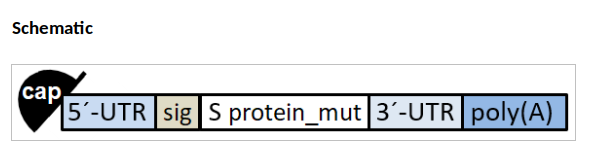
This is a sort of table of contents. We’ll start with the ‘cap’, actually
depicted as a little hat.
Much like you can’t just plonk opcodes in a file on a computer and run it,
the biological operating system requires headers, has linkers and things
like calling conventions.
The code of the vaccine starts with the following two nucleotides:
GA
This can be compared very much to every [DOS and Windows executable starting
with MZ](https://en.wikipedia.org/wiki/DOS_MZ_executable) , or UNIX scripts starting with
#!
. In both life and
operating systems, these two characters are not executed in any way. But
they have to be there because otherwise nothing happens.
The mRNA ‘cap’ [has a number of
functions](https://en.wikipedia.org/wiki/Five-prime_cap#Function) . For one, it marks code as coming
from the nucleus. In our case of course it doesn’t, our code comes from a
vaccination. But we don’t need to tell the cell that. The cap makes our code
look legit, which protects it from destruction.
The initial two GA nucleotides are also chemically slightly different from
the rest of the RNA. In this sense, the GA has some out-of-band
signaling on it.
The “five-prime untranslated region”
Some lingo here. RNA molecules can only be read in one direction.
Confusingly, the part where the reading begins is called the 5’ or
‘five-prime’. The reading stops at the 3’ or three-prime end.
Life consists of proteins (or things made by proteins). And these proteins
are described in RNA. When RNA gets converted into proteins, this is called
translation.
Here we have the 5’ untranslated region (‘UTR’), so this bit does not end up
in the protein:
GAAΨAAACΨAGΨAΨΨCΨΨCΨGGΨCCCCACAGACΨCAGAGAGAACCCGCCACC
Here we encounter our first surprise. The normal RNA characters are A, C, G
and U. U is also known as ’T’ in DNA. But here we find a Ψ, what is going
on?
This is one of the exceptionally clever bits about the vaccine. Our body
runs a powerful antivirus system (“the original one”). For this reason,
cells are extremely unenthusiastic about foreign RNA and try very hard to
destroy it before it does anything.
This is somewhat of a problem for our vaccine – it needs to sneak past our
immune system. Over many years of experimentation, it was found that if the
U in RNA is replaced by a slightly modified molecule, our immune system
loses interest. For real.
So in the BioNTech/Pfizer vaccine, every U has been replaced by
1-methyl-3’-pseudouridylyl, denoted by Ψ. The really clever bit is that
although this replacement Ψ placates (calms) our immune system, it is
accepted as a normal U by relevant parts of the cell.
In computer security we also know this trick – it sometimes is possible to
transmit a slightly corrupted version of a message that confuses firewalls and
security solutions, but that is still accepted by the backend servers –
which can then get hacked.
We are now reaping the benefits of fundamental scientific research performed
in the past. The
of this Ψ technique had to fight to get
work funded and then accepted. We should all be very grateful, and I am sure
the [Nobel prizes will arrive in due
course](https://twitter.com/PowerDNS_Bert/status/1329861047168225281) .
Many people have asked, could viruses also use the Ψ technique to beat our
immune systems? In short, this is extremely unlikely. Life simply does
not have the machinery to build 1-methyl-3’-pseudouridylyl nucleotides.
Viruses rely on the machinery of life to reproduce themselves, and this
facility is simply not there. The mRNA vaccines quickly degrade in the
human body, and there is no possibility of the Ψ-modified RNA
replicating with the Ψ still in there. “[No, Really, mRNA Vaccines Are Not Going To Affect Your
DNA](https://www.deplatformdisease.com/blog/no-really-mrna-vaccines-are-not-going-to-affect-your-dna )“
is also a good read.
Ok, back to the 5’ UTR. What do these 51 characters do? As everything in
nature, almost nothing has one clear function.
When our cells need to translate RNA into proteins, this is done using a
machine called the ribosome. The ribosome is like a 3D printer for
proteins. It ingests a strand of RNA and based on that it emits a string of
amino acids, which then fold into a protein.
Source: Wikipedia user Bensaccount

This is what we see happening above. The black ribbon at the bottom is RNA.
The ribbon appearing in the green bit is the protein being formed. The
things flying in and out are amino acids plus adaptors to make them fit on
RNA.
This ribosome needs to physically sit on the RNA strand for it to get to
work. Once seated, it can start forming proteins based on further RNA it
ingests. From this, you can imagine that it can’t yet read the parts where
it lands on first. This is just one of the functions of the UTR: the
ribosome landing zone. The UTR provides ‘lead-in’.
In addition to this, the UTR also contains metadata: when should translation
happen? And how much? For the vaccine, they took the most ‘right now’ UTR
they could find, taken from the [alpha globin
gene](https://www.tandfonline.com/doi/full/10.1080/15476286.2018.1450054) .
This gene is known to robustly produce a lot of proteins. In previous
years, scientists had already found ways to optimize this UTR even further
(according to the WHO document), so this is not quite the alpha globin UTR.
It is better.
The S glycoprotein signal peptide
As noted, the goal of the vaccine is to get the cell to produce copious
amounts of the Spike protein of SARS-CoV-2. Up to this point, we have mostly
encountered metadata and “calling convention” stuff in the vaccine source
code. But now we enter the actual viral protein territory.
We still have one layer of metadata to go however. Once the ribosome (from the
splendid animation above) has made a protein, that protein still needs to go
somewhere. This is encoded in the “S glycoprotein signal peptide (extended leader
sequence)“.
The way to see this is that at the beginning of the protein there is a sort
of address label – encoded as part of the protein itself. In this specific
case, the signal peptide says that this protein should exit the cell via the
“endoplasmic reticulum”. Even Star Trek lingo is not as fancy as this!
The “signal peptide” is not very long, but when we look at the code, there
are differences between the viral and vaccine RNA:
(Note that for comparison purposes, I have replaced the fancy modified Ψ by a
regular RNA U)
           3   3   3   3   3   3   3   3   3   3   3   3   3   3   3   3
Virus:   AUG UUU GUU UUU CUU GUU UUA UUG CCA CUA GUC UCU AGU CAG UGU GUU
Vaccine: AUG UUC GUG UUC CUG GUG CUG CUG CCU CUG GUG UCC AGC CAG UGU GUG
               !   !   !   !   ! ! ! !     !   !   !   !   !           !
So what is going on? I have not accidentally listed the RNA in groups of 3
letters. Three RNA characters make up a codon. And every codon encodes for a
specific amino acid. The signal peptide in the vaccine consists of exactly
the same amino acids as in the virus itself.
So how come the RNA is different?
There are 4³=64 different codons, since there are 4 RNA characters, and
there are three of them in a codon. Yet there are only 20 different
amino acids. This means that multiple codons encode for the same amino acid.
Life uses the following nearly universal table for mapping RNA codons to
amino acids:
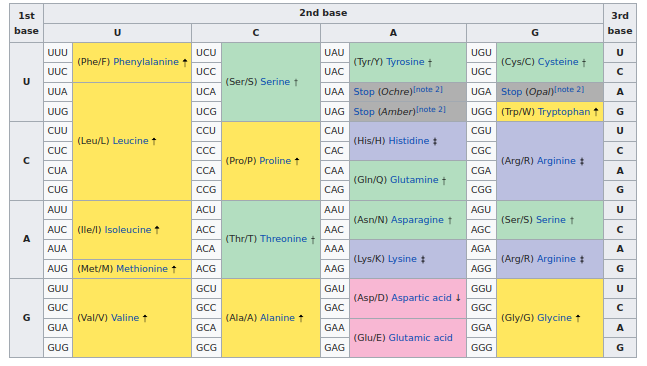
The RNA codon table (Wikipedia)
In this table, we can see that the modifications in the vaccine (UUU ->
UUC) are all synonymous. The vaccine RNA code is different, but the same
amino acids and the same protein come out.
If we look closely, we see that the majority of the changes happen in the
third codon position, noted with a ‘3’ above. And if we check the universal
codon table, we see that this third position indeed often does not matter
for which amino acid is produced.
So, the changes are synonymous, but then why are they there? Looking
closely, we see that all changes except one lead to more C and Gs.
So why would you do that? As noted above, our immune system takes a very dim
view of ‘exogenous’ RNA, RNA code coming from outside the cell. To evade
detection, the ‘U’ in the RNA was already replaced by a Ψ.
However, it turns out that RNA with [a higher
amount](https://www.nature.com/articles/nrd.2017.243 ) of Gs and Cs is
also [converted more efficiently into
proteins](https://www.ncbi.nlm.nih.gov/pmc/articles/PMC1463026/) ,
And this has been achieved in the vaccine RNA by replacing many characters
with Gs and Cs wherever this was possible.
I’m slightly fascinated by the one change that did not lead to an
additional C or G, the CCA -> CCU modification. If anyone knows the reason,
please let me know! Note that I’m aware that some codons are more common
than others in the human genome, but [I also read that this does not
influence translation speed a
lot](https://journals.plos.org/plosgenetics/article?id=10.1371/journal.pgen.1006024) .
The actual Spike protein
The next 3777 characters of the vaccine RNA are similarly ‘codon optimized’
to add a lot of C’s and G’s. In the interest of space I won’t list all
the code here, but we are going to zoom in on one exceptionally special
bit. This is the bit that makes it work, the part that will actually help us
return to life as normal:
                  *   *
          L   D   K   V   E   A   E   V   Q   I   D   R   L   I   T   G
Virus:   CUU GAC AAA GUU GAG GCU GAA GUG CAA AUU GAU AGG UUG AUC ACA GGC
Vaccine: CUG GAC CCU CCU GAG GCC GAG GUG CAG AUC GAC AGA CUG AUC ACA GGC
          L   D   P   P   E   A   E   V   Q   I   D   R   L   I   T   G
           !     !!! !!        !   !       !   !   !   ! !
Here we see the usual synonymous RNA changes. For example, in the first
codon we see that CUU is changed into CUG. This adds another ‘G’ to the
vaccine, which we know helps enhance protein production. Both CUU
and CUG encode for the amino acid ‘L’ or Leucine, so nothing changed in the
protein.
When we compare the entire Spike protein in the vaccine, all changes are
synonymous like this.. except for two, and this is what we see here.
The third and fourth codons above represent actual changes. The K and V
amino acids there are both replaced by ‘P’ or Proline. For ‘K’ this required
three changes (‘!!!’) and for ‘V’ it required only two (‘!!’).
**It turns out that these two changes enhance the vaccine efficiency
enormously**.
So what is happening here? If you look at a real SARS-CoV-2 particle, you
can see the Spike protein as, well, a bunch of spikes:
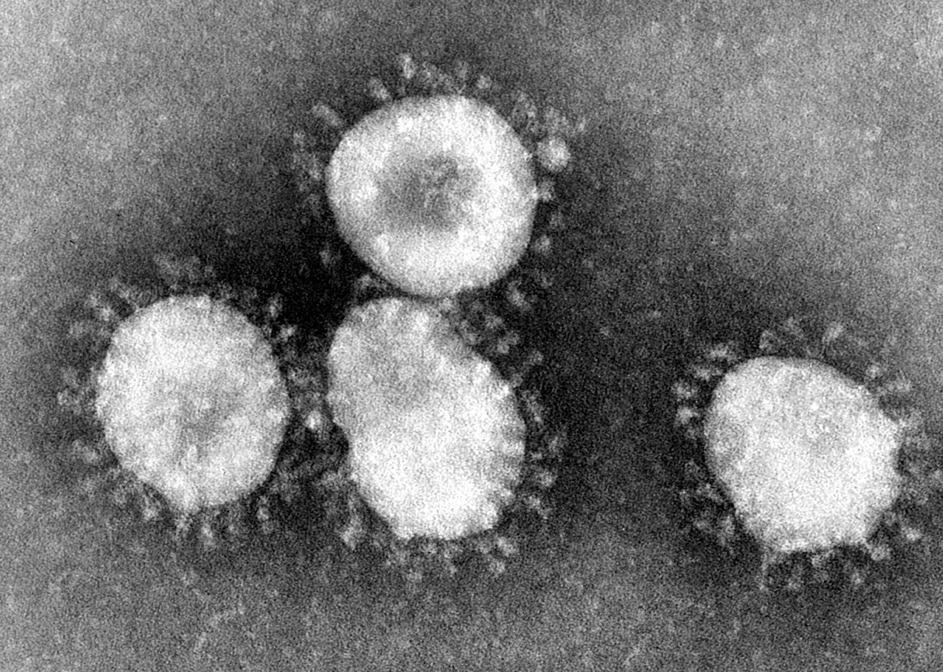
SARS virus particles (Wikipedia)
The spikes are mounted on the virus body (‘the nucleocapsid protein’). But
the thing is, our vaccine is only generating the spikes itself, and we’re
not mounting them on any kind of virus body.
It turns out that, unmodified, freestanding Spike proteins collapse into a
different structure. If injected as a vaccine, this would indeed cause our
bodies to develop immunity.. but only against the collapsed spike protein.
And the real SARS-CoV-2 shows up with the spiky Spike. The vaccine would not
work very well in that case.
So what to do? In [2017 it was described how putting a double Proline
substitution in just the right
place](https://www.ncbi.nlm.nih.gov/pmc/articles/PMC5584442/ ) would make the
SARS-CoV-1 and MERS
S proteins take up their ‘pre-fusion’ configuration, even without being part of
the whole virus. This works [because Proline is a very rigid amino
acid](https://cen.acs.org/pharmaceuticals/vaccines/tiny-tweak-behind-COVID-19/98/i38) . It
acts as a kind of splint, stabilising the protein in the state we need to
show to the immune system.
The people that
discovered this should be walking
around high-fiving themselves incessantly. Unbearable amounts of smugness
should be emanating from them. [And it would all be well
deserved](https://twitter.com/McLellan_Lab/status/1291077489566142464) .
Update! I have been contacted by the [McLellan
lab](https://twitter.com/McLellan_Lab/status/1291077489566142464) , one of the
groups behind the Proline discovery. They tell me the high-fiving is
subdued because of the ongoing pandemic, but they are pleased to have
contributed to the vaccines. They also stress the importance of many other
groups, workers and volunteers.
The end of the protein, next steps
If we scroll through the rest of the source code, we encounter some small
modifications at the end of the Spike protein:
          V   L   K   G   V   K   L   H   Y   T   s
Virus:   GUG CUC AAA GGA GUC AAA UUA CAU UAC ACA UAA
Vaccine: GUG CUG AAG GGC GUG AAA CUG CAC UAC ACA UGA UGA
          V   L   K   G   V   K   L   H   Y   T   s   s
               !   !   !   !     ! !   !          !
At the end of a protein we find a ‘stop’ codon, denoted here by a lowercase
’s’. This is a polite way of saying that the protein should end here. The
original virus uses the UAA stop codon, the vaccine uses two UGA stop
codons, perhaps just for good measure.
The 3’ Untranslated Region
Much like the ribosome needed some lead-in at the 5’ end, where we found the
‘five prime untranslated region’, at the end of a protein coding region we find a similar
construct called the 3’ UTR.
Many words could be written about the 3’ UTR, but here I quote [what the
Wikipedia
says](https://en.wikipedia.org/wiki/Three_prime_untranslated_region) : “The 3’-untranslated region plays a crucial role in gene
expression by influencing the localization, stability, export, and
translation efficiency of an mRNA .. **despite our current understanding of
3’-UTRs, they are still relative mysteries**”.
What we do know is that certain 3’-UTRs are very successful at promoting
protein expression. According to the WHO document, the BioNTech/Pfizer
vaccine 3’-UTR was picked from “the amino-terminal enhancer of split (AES)
mRNA and the mitochondrial encoded 12S ribosomal RNA to confer RNA stability
and high total protein expression”. To which I say, well done.
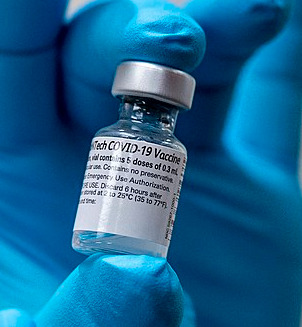
The AAAAAAAAAAAAAAAAAAAAAA end of it all
The very end of mRNA is polyadenylated. This is a fancy way of saying it
ends on a lot of AAAAAAAAAAAAAAAAAAA. Even mRNA has had enough of 2020 it
appears.
mRNA can be reused many times, but as this happens, it also loses some of
the A’s at the end. Once the A’s run out, the mRNA is no longer functional
and gets discarded. In this way, the ‘poly-A’ tail is protection from
degradation.
Studies have been done to find out what the optimal number of A’s at the end
is for mRNA vaccines. I read in the open literature that this peaked at 120
or so.
The BNT162b2 vaccine ends with:
                                     ****** ****
UAGCAAAAAA AAAAAAAAAA AAAAAAAAAA AAAAGCAUAU GACUAAAAAA AAAAAAAAAA
AAAAAAAAAA AAAAAAAAAA AAAAAAAAAA AAAAAAAAAA AAAAAAAAAA AAAA
This is 30 A’s, then a “10 nucleotide linker” (GCAUAUGACU), followed by another 70
A’s.
There are various theories why this linker is there. Some people tell me it
has to do with DNA plasmid stability, I have also received this from an
actual expert:
“The 10-nucleotide linker within the poly(A) tail makes it easier to stitch
together the synthetic DNA fragments that become the template for transcribing
the mRNA. It also reduces slipping by T7 RNA polymerase so that the
transcribed mRNA is more uniform in length”.
Summarising
With this, we now know the exact mRNA contents of the BNT162b2 vaccine, and
for most parts we understand why they are there:
The CAP to make sure the RNA looks like regular mRNA
A known successful and optimized 5’ untranslated region (UTR)
A codon optimized signal peptide to send the Spike protein to the right
place (copied 100% from the original virus)
A codon optimized version of the original spike, with two ‘Proline’
substitutions to make sure the protein appears in the right form
A known successful and optimized 3’ untranslated region
A slightly mysterious poly-A tail with an unexplained ‘linker’ in there
The codon optimization adds a lot of G and C to the mRNA. Meanwhile, using Ψ
(1-methyl-3’-pseudouridylyl) instead of U helps evade our immune system, so
the mRNA stays around long enough so we can actually help train the immune
system.
Further reading/viewing
In 2017 I held a two hour presentation on DNA, which you can [view
here](https://berthub.eu/dna) . Like this page it is aimed at computer
people.
In addition, I’ve been maintaining a page on ‘[DNA for
programmers](https://berthub.eu/amazing-dna )’ since 2001.
You might also enjoy [this introduction to our amazing immune
system](https://berthub.eu/articles/posts/immune-system/) .
Finally, this listing of my blog posts has quite some
DNA, SARS-CoV-2 and COVID related material.